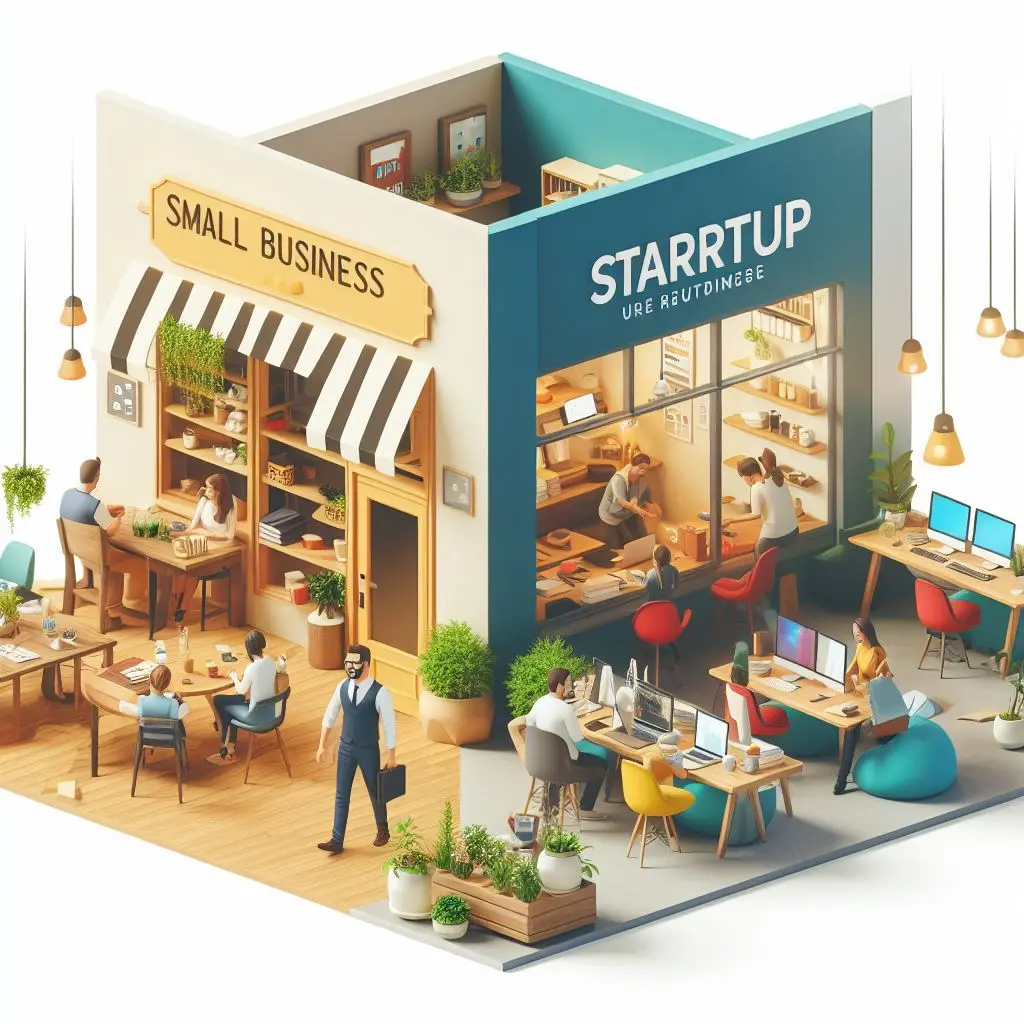
Differences between small business and startup
In the vibrant world of entrepreneurship, small businesses and startups are often grouped together. However, understanding the fundamental differences between small business and startup is crucial for aspiring entrepreneurs, investors, and policymakers. This comprehensive exploration delves into the nuances that distinguish small businesses from startups, shedding light on their unique characteristics, goals, and contributions to the economy.
1. Vision and Growth Ambitions
One of the most significant distinctions lies in their vision and growth ambitions. Startups are typically founded with a grand vision to disrupt an existing industry or create an entirely new market. They aspire to achieve rapid, exponential growth, often aiming to become global players. This ambitious growth trajectory is often fueled by venture capital funding, allowing startups to scale their operations and reach a wider audience quickly.
On the other hand, small businesses are often content with serving a local or niche market. Their growth is usually organic and gradual, focusing on profitability and sustainability. While small businesses may experience growth over time, their primary goal is to provide a steady income for the owner(s) and contribute to the local community.
2. Business Models and Innovation
Startups frequently operate with innovative or disruptive business models. These models may be unproven and require continuous iteration and refinement. The emphasis on innovation is a hallmark of startups, as they strive to challenge the status quo and introduce new solutions to existing problems.
In contrast, small businesses typically operate with established and proven business models. They rely on tried-and-tested approaches to minimize risk and ensure a steady income stream. Small businesses may not be at the forefront of innovation, but they play a vital role in providing essential goods and services to their communities.
3. Funding and Financial Resources
Startups often rely heavily on external funding to fuel their ambitious growth plans. They seek investments from venture capitalists, angel investors, or through crowdfunding campaigns. This reliance on external capital allows startups to invest in research and development, marketing, and talent acquisition, enabling them to scale rapidly.
Small businesses, on the other hand, primarily rely on personal savings, bank loans, or small business grants. They are often bootstrapped, meaning they finance their operations through their own revenue and resources. While this approach may limit their growth potential, it also allows small businesses to maintain control and independence.
4. Risk Profile and Exit Strategies
Startups are inherently riskier ventures than small businesses. Their unproven business models and rapid growth ambitions expose them to higher risks of failure. However, the potential rewards for successful startups are also significant, with exit strategies often involving acquisitions by larger companies or initial public offerings (IPOs).
Small businesses generally have a lower risk profile due to their established business models and steady growth trajectories. Their exit strategies may involve selling the business to a new owner, passing it down to family members, or simply closing the business when the owner retires.
5. Innovation and Scalability
Innovation is at the core of many startups. They strive to create disruptive technologies, products, or services that can be scaled rapidly to reach a global audience. This focus on scalability is essential for attracting investors and achieving exponential growth.
While small businesses may innovate within their niche, their primary focus is on providing quality products or services to their local community. Scalability may not be a top priority, as their goal is to maintain a sustainable and profitable business within their chosen market.
6. Organizational Structure and Culture
Startups often have a flat organizational structure with a flexible and dynamic work environment. They value creativity, agility, and a willingness to take risks. The culture is often results-oriented, with employees working long hours and wearing multiple hats.
Small businesses tend to have a more traditional hierarchical structure with clearly defined roles and responsibilities. The culture is often more stable and predictable, emphasizing customer service, loyalty, and community engagement.
7. Examples and Industries
Startups are prevalent in the technology sector, where innovation and disruption are highly valued. Examples of successful startups include Airbnb, Uber, Dropbox, and Slack. These companies have revolutionized their respective industries and achieved remarkable growth in a short period.
Small businesses are found in various sectors, including retail, hospitality, professional services, and healthcare. Examples include local bakeries, family-owned restaurants, independent bookstores, and neighborhood repair shops. These businesses are integral to the fabric of their communities, providing essential goods and services and fostering local economic development.
8. Impact on the Economy
Both small businesses and startups play crucial roles in the economy. Small businesses are the backbone of many local economies, providing employment opportunities, generating revenue, and supporting community initiatives.
Startups, while fewer in number, have the potential to drive significant economic growth through innovation, job creation, and global expansion. They often introduce new technologies and business models that can transform industries and create new markets.
Choosing the Right Path
Aspiring entrepreneurs must carefully consider their personal goals, risk tolerance, and aspirations when deciding whether to start a small business or a startup. If they have a groundbreaking idea with the potential to disrupt an industry and are willing to take risks for the chance of massive success, a startup might be the right path. However, if they prefer a more stable and predictable path with a focus on serving their local community, a small business may be a better fit.
In Conclusion
Small businesses and startups are both vital components of the entrepreneurial ecosystem. While they share a common entrepreneurial spirit, they differ in their vision, growth ambitions, business models, funding sources, risk profiles, and impact on the economy. Understanding these differences is crucial for entrepreneurs, investors, and policymakers to make informed decisions and support the growth of both small businesses and startups. By recognizing their unique contributions and fostering a supportive environment, we can ensure that both small businesses and startups continue to thrive and contribute to economic development and innovation.